The Chair Method Reviewed: Slow, Gentle, Demanding
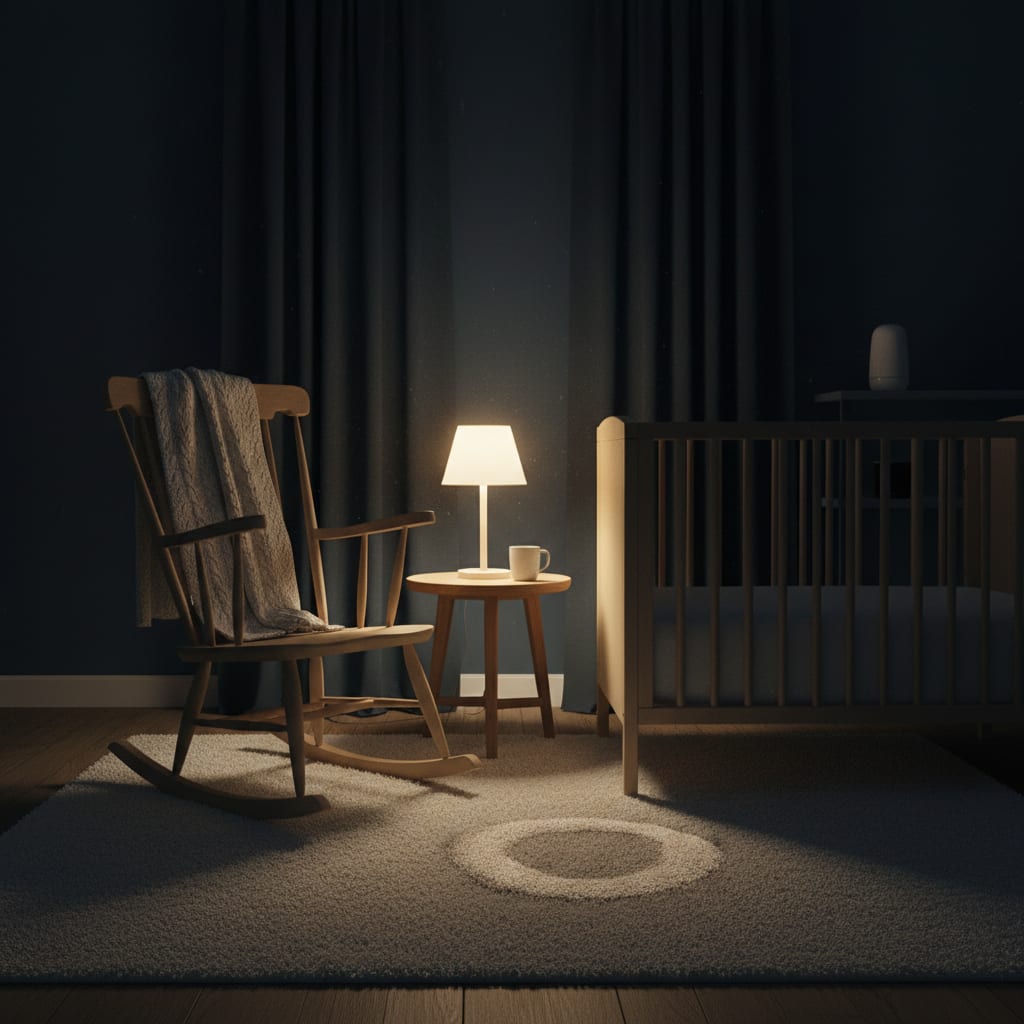
The chair method is sleep training with you still in the room: your baby goes into the crib awake, you sit in a chair beside it while they fall asleep, and every few nights you move the chair farther away until you’re outside the door. It usually takes one to two weeks, produces less intense crying than leaving the room, and asks more of the parent than any method except pick-up-put-down. It suits families who cannot bear to walk out — and it fails, reliably, when the retreat schedule quietly stops moving.
I’m a working sleep consultant, and the chair is the method families ask me for by name most often. Here’s the honest review.
How the chair method actually runs
Position one is beside the crib, close enough to touch the rail. You sit. You do not rock, lift, feed, or narrate. Most versions allow a periodic shush or a hand on the mattress, and every version agrees that the less interactive you are, the faster it works. After roughly two to three nights at each station you move: crib-side, mid-room, doorway, hallway, gone. Five positions, about a fortnight, in the tidy version. The best-known branded version is Kim West’s Sleep Lady Shuffle. It keeps the same retreat but lets you give active verbal and physical comfort from the chair and then taper it, where a generic chair method usually asks you to sit quietly. I’ve covered the branded program separately in my Sleep Lady Shuffle review.
The mechanism is the same one under every method — your baby practises falling asleep without being put there — but delivered in slices. You are subtracting your presence a little at a time instead of all at once, which is why the crying tends to be lower-intensity and longer-running than the graduated check-in approach.
Before any of it: the readiness gate. Roughly four months adjusted age at the earliest, your pediatrician in the loop, and no unresolved medical questions — reflux, breathing worries, anything that makes night crying a symptom rather than a protest. My when NOT to sleep train checklist is the pre-flight, and it outranks any method decision.
The retreat schedule is the whole method
Here’s the part that gets lost. The chair isn’t the intervention; the moving is. A parent sitting crib-side indefinitely has not gentled sleep training — they have installed themselves as the new sleep association, one that now requires an adult to sit in the dark for forty minutes twice a day.
In consults, the pattern I see is families four weeks in, still at position two, describing the method as “working slowly.” It isn’t working slowly. It’s stalled, because moving from crib-side to mid-room usually produces a bad night, and a bad night after a run of good ones feels like a mistake rather than the expected cost of progress.
Write the schedule down before night one, including the dates. Move on the date even when the previous night was good, because the good night is precisely what earned the move.
Why it collapses around night five
Nights one and two are hard but energising — you’re doing something, you’re right there. Night five is where the chair loses families, for three reasons that have nothing to do with the baby.
Boredom is a real variable. Sitting motionless in a dark room while your child protests, doing approximately nothing, is harder for many parents than leaving. Several families I’ve worked with discovered mid-plan that they would rather have left the room after all — which is useful information, but expensive to learn on night five.
Presence invites negotiation. Some babies escalate when a parent is visible and unhelpful; the chair reads as a broken promise. Those babies do better with an approach that removes the ambiguity — extinction at one end, fading and no-cry approaches at the other.
Two parents, two chairs. If one parent shushes and one doesn’t, or one caves at 2am, the baby learns that protest length determines which parent arrives. Intermittent reinforcement is the strongest training schedule there is, and the chair method offers it more opportunities than any other.
Which families the chair actually fits
- Parents who cannot leave the room, and know it. Not “would prefer not to” — genuinely cannot. The chair converts an unusable plan into a usable one, and a usable plan beats a theoretically faster one every time.
- Toddlers in beds. Once a child can climb out, leaving the room becomes a chase. Presence-based approaches carry their weight in the 18-month-and-up crowd.
- Anxious households with time. Two weeks of moderate difficulty is an easier sell than three nights of acute difficulty for some couples, and that trade is legitimate.
- Room-sharers with a plan to stop. If you’re in one room by necessity, the chair is one of the few methods that starts where you already are.
Poor fits: babies who ramp up dramatically at the sight of a stationary parent; households where only one adult is on board; anyone who needs this resolved before a return-to-work date next Tuesday. The full method comparison sets the chair against the faster options side by side.
What the evidence supports saying
Honest answer: less than the marketing implies. Presence-based fading approaches sit inside the broader family of behavioural interventions that the research supports, but the chair method specifically has not been isolated in the way graduated extinction has. What we can say is that structured behavioural approaches applied at appropriate ages improve infant sleep, and follow-up work — including the five-year follow-up published in Pediatrics — has not found lasting harms. Anyone quoting a specific chair-method success rate is quoting their own client base, not a literature.
What I’d tell a client
Choose the chair because you know you can’t leave the room — not because it sounds kinder. It is a two-week commitment with a written retreat schedule you follow on the calendar, not on the vibe of last night. Be boring in that chair: no eye contact games, no running commentary, no lifting. And if you’re still crib-side at week three, you haven’t chosen a gentle method, you’ve chosen a new bedtime job. At that point switch deliberately rather than drifting.
FAQ: the chair method
How long does the chair method take?
Usually one to two weeks to reach the doorway if you move stations every two to three nights and stay consistent. Slower is common; slower than three weeks usually means the retreat schedule stopped moving rather than that your baby is unusual.
Should I make eye contact or talk from the chair?
Keep it minimal. A brief shush or a hand on the mattress is enough. Conversation, eye contact and back-rubbing turn the chair into an interactive bedtime service, which is exactly the association you’re trying to retire.
What if my baby cries harder because I’m sitting there?
That’s a recognised pattern, not a failure of nerve. Some babies find a visible, unresponsive parent more provoking than an absent one. Give it three or four nights; if protest is clearly worse with you present, that’s real information — switch to a method that removes the ambiguity rather than grinding on.
Can I use the chair method for night wakings too?
Yes, and consistency across bedtime and night wakings is what makes it work — but overnight feeds are a separate question that belongs with your pediatrician, not with a method chart. Decide the feeding plan with them first, then apply the chair to everything that isn’t a planned feed.