Virtual Sleep Consultants: What You Get Over Video
A virtual sleep consultant works with you remotely: an intake form, a call by video or phone, a written plan, then a stretch of messages or check-in calls while you run the nights yourself. For a healthy baby, that covers most of what an in-home visit would. Video can show the consultant the room, the crib and how you settle your baby. It can’t measure the room’s temperature or noise, it doesn’t put anyone in your house at 2 a.m., and it can’t assess your baby’s health. No consultant can do that last part. That’s your pediatrician.
I make my living in this industry, so here’s what each format can and can’t do, including the free one.
The four formats, side by side
Most sleep help is sold in one of four shapes. What separates them is what the helper can observe and how long they stay with you. How much each format costs has its own breakdown, so I’ll leave prices to that page.
| Format | What they can observe | What they can’t | Suits |
|---|---|---|---|
| Self-guided course | Nothing. You apply a general plan | Your baby, your room, your setbacks | Parents who agree on a method and mostly need the steps |
| Single video consult | The room on camera, your answers, maybe one recorded bedtime | How the plan goes on night three | A second opinion on a plan you already have |
| Virtual package with a support window | All of the above, plus your logs and messages through the first week or two | Temperature, sound levels, the night as it happens | Most families who hire anyone |
| In-home or overnight | Everything in the room, in person | Nothing format-related, but you pay for presence | Narrow cases where execution keeps falling apart |
What a video call actually sees
In consults, the pattern I see is that the intake form and a few nights of sleep logs tell me more than the call itself does. The call adds three things a form can’t.
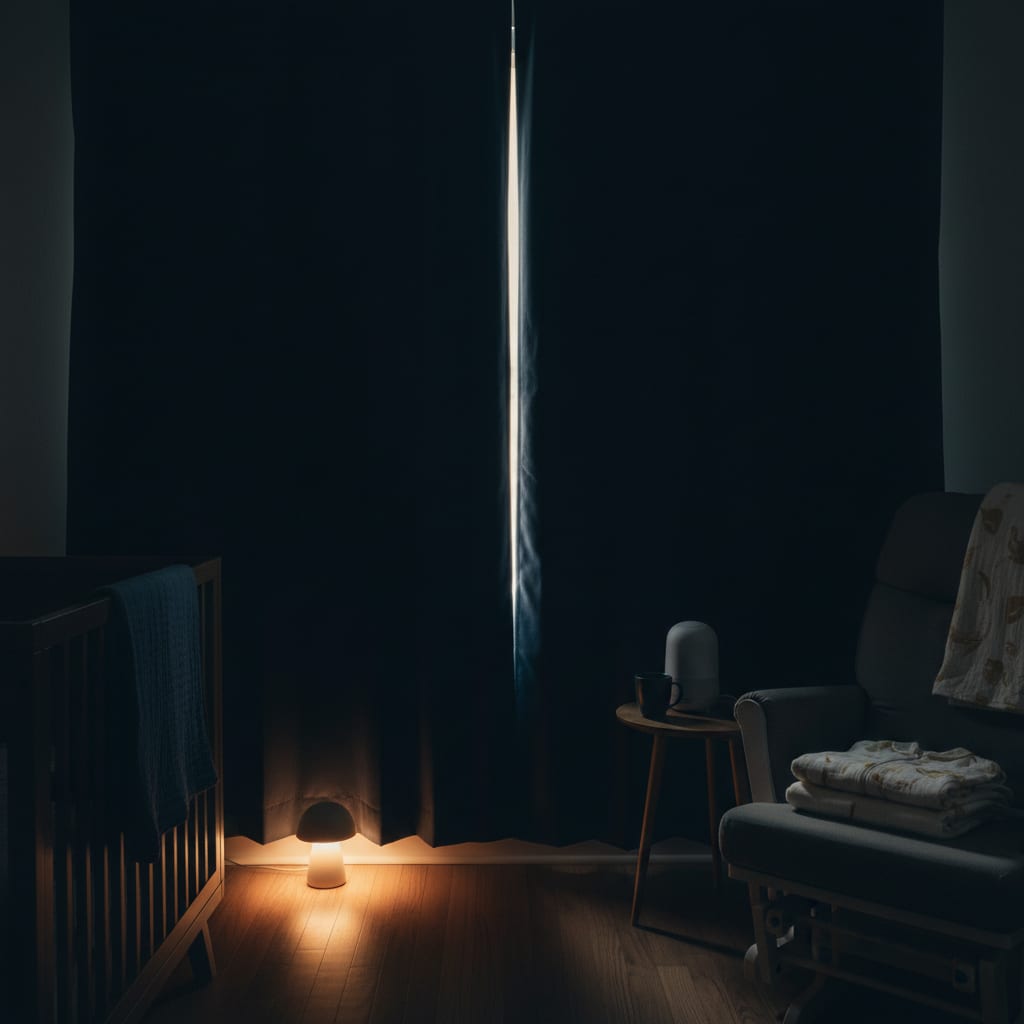
The room. A slow camera sweep shows me where the light leaks in, what’s in the crib, where the monitor sits and how far the crib is from the door. Parents often describe a “dark” room that turns out to have a streetlight-sized gap at the curtain edge.
The routine. Some families record a bedtime, or keep the camera on for the last ten minutes. I’m watching the order of steps and how long the final feed runs. Mostly I’m watching what happens in the minute you put the baby down, because that minute is usually the whole problem.
Your settling response. How you pick up, what you say, how quickly you return. A written plan only helps if it starts from what you actually do, not from what you think you do.
What it can’t see
- Temperature. A phone camera can’t feel a warm room. Put a simple digital room thermometer, such as the TempPro TP50, in the nursery and read the number out.
- Sound. Phone microphones flatten background noise, so I can’t judge how loud the sound machine or the street really is.
- Your baby’s health. Reflux, breathing pauses, weight gain, feeding trouble: that’s a pediatrician conversation, full stop, whatever the format. A responsible virtual consultant will ask whether your pediatrician has cleared sleep work before starting.
- The hard night itself. On the bad night you’re on your own unless the package includes messaging, and even then, someone answering in the morning is not someone standing in the hallway.
That last point is what the support window is for, and it’s the part worth comparing.
What a real virtual package contains
As a worked example, The Sleep Lady’s package page for 6 months to 6 years, which I checked in October 2026, lists three tiers:
- The Sleep Star ($225): a review of your history form, a one-hour consult, a sleep plan, resources and Kim West’s book Good Night, Sleep Tight.
- The Sleep Overhaul ($375): all of that, plus daily written feedback, text messaging, a final 30-minute call and one 30-minute follow-up call to use within a year.
- The Sleep Overhaul PLUS ($500): three follow-up calls instead of one, plus four months’ access to an online programme the page abbreviates as GSS.
The page also offers a free 15-minute assessment call, and says plainly that it comes with no written plan. What the page doesn’t say is whether the one-hour consult is by video or phone. Ask. My Sleep Lady Shuffle review covers the method itself.
The shape matters more than the brand. The cheapest tier is a plan and a call. The tiers above it buy days of feedback while you carry the plan out. In my experience, the feedback is what families end up valuing, because nights two to five are when plans fall apart.
Does remote help even work?
There’s decent evidence that sleep advice doesn’t need to be delivered in person. A 2011 randomised trial in Sleep followed 264 mothers of babies and toddlers aged 6 to 36 months for three weeks. Families got personalised recommendations from a fully online, algorithm-based tool, with or without a prescribed bedtime routine. Both groups improved on time to fall asleep and on night waking within a week, and mothers’ sleep and mood improved too. A one-year follow-up, with 171 of the 264 mothers responding, found the gains held.
The limits are real: sleep was reported by mothers, not measured. Johnson & Johnson Consumer Companies funded the study, and three of the authors were its employees. The paper itself says online tools have “limited ability to tailor to every unforeseen variation in sleep issues”. My reading: the advice travels fine. A human adds the tailoring when your baby does something the plan didn’t expect.
Questions to ask about the format before you book
My guide to vetting a sleep consultant covers credentials and red flags. These questions are about the format:
- Is the consult by video or phone, and can I record it?
- How many days of support are included, and when does the clock start?
- What are the messaging hours, and how quickly do you usually reply?
- Will you review monitor footage, and how do you store it?
- What happens if we need a few more days?
It’s video of your child’s bedroom, so ask where it’s kept and for how long.
When in-home is worth paying for
Rarely: when the plan is sound but no adult in the house can carry it out alone, such as a parent recovering from surgery or multiples on opposite schedules. In those cases the expensive part is the presence, not the plan. If a seller can’t explain why your situation needs someone in the room, it probably doesn’t.
The free version of this advice
Before any format, try the free one. Pick one well-described method, keep a short log for a week, and get your pediatrician to rule out anything medical. My list of free baby sleep resources collects the ones I’d send a client to first.
What I’d tell a client
Virtual is enough for most families, and the call isn’t what you’re paying for. The days after it are. Compare packages on how long someone stays with you and how fast they reply, not on how long the first call runs. Show me the room, keep the log, and keep your pediatrician in the loop for anything medical.
FAQ: virtual sleep consultants
Is a virtual sleep consultant as good as one in person?
For most healthy babies, yes. The plan and the follow-up are the same either way, and a camera tour covers most of what an in-person visit would see. In-home help mainly adds a person physically there on hard nights.
Do I have to be on camera at bedtime?
Usually not. Many consultants work from an intake form, a sleep log and one call. A recorded bedtime helps if settling is the sticking point. Ask how they’ll use and store any footage.
Can a virtual consultant help with a newborn?
Some do, The Sleep Lady among them, but newborn sleep is mostly about feeding and safe-sleep setup rather than training. Your pediatrician should come first for weight, feeding and any medical question.
What should I have ready for the first call?
A few nights of written sleep logs, a room thermometer reading, a phone you can walk around the nursery with, and a list of what you’ve already tried.