White Noise Done Right: Volume, Distance, Duration
Three numbers cover almost everything about white noise for babies: keep the volume around 50 decibels at the baby’s ear, keep the machine at least seven feet from the sleep space, and run it continuously through the whole sleep rather than on a timer. The American Academy of Pediatrics’ guidance on infant sound machines is to place them as far from the baby as practical, set the volume as low as the job allows, and limit how long they run. Those are the whole rules. Everything else sold alongside them — light shows, heartbeat modes, app-controlled palettes of forty sounds — is decoration.
I’m a working sleep consultant, and sound is the environment fix I spend the least time explaining and see set up wrong most often. Usually it’s too loud and too close.
Why the distance rule exists
A widely cited 2014 study in Pediatrics tested fourteen infant sound machines and found that at maximum output every one of them exceeded the noise limits recommended for hospital newborn nurseries, and all but one could still exceed 50 decibels from across the room. That’s the origin of the guidance you’ll see repeated everywhere: the risk isn’t white noise, it’s white noise played loudly a few inches from an infant’s ear for eleven hours a night.
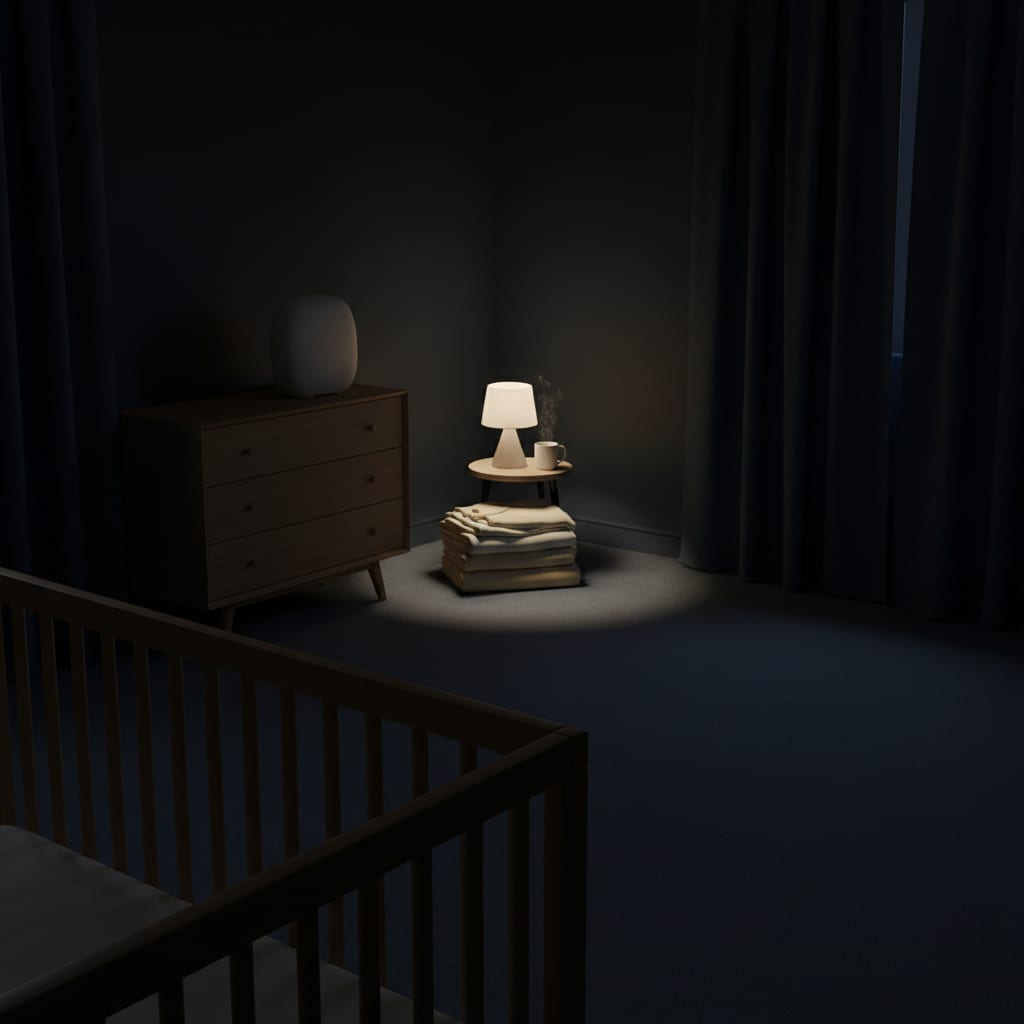
So the fix is free and it is mostly geometry. Put the machine on a dresser or shelf on the far side of the room, pointed away from the crib rather than at it. Never clip it to the rail, never put it inside the crib, and never use a pillow speaker or a phone under the mattress. Sound falls off fast with distance, which means the same machine that’s uncomfortably loud at the rail is perfectly judged from seven or eight feet.
Getting the volume right without a meter
Fifty decibels is roughly the level of a quiet shower heard from the next room, or a soft rainfall. Two practical ways to hit it:
- The conversation test. Stand at the crib. If you’d have to raise your voice to be heard by someone standing next to you, it’s too loud. You should be able to talk normally over it.
- A free sound-level app. Any phone decibel meter is imprecise, but it’s far better than guessing. Hold it where the baby’s head goes, read the number, and adjust. If it sits in the forties and fifties, you’re in sensible territory.
Then leave it there. The single most common mistake I find in homes is volume creep — a parent nudges it up during a rough week to cover a barking dog, never nudges it back, and six weeks later the room is running at conversation volume all night.
Continuous, not timed
Most machines default to a thirty- or sixty-minute timer, and most parents never change it. That default is backwards for the problem you’re solving. Sound masking earns its keep at the light-sleep transitions between cycles, which for a young baby come round roughly every forty-five minutes to an hour — precisely when the timer has just cut out. Worse, the sudden disappearance of a sound is itself a change in the environment, and change at a light-sleep moment is exactly what wakes a baby.
Run it from the start of the sleep to the end of it, naps included, at the same volume every time. Consistency is the active ingredient: the sound becomes a boring, reliable signal that this is sleep, and boring is the goal.
Which sound, and does the type matter
True white noise, pink noise, brown noise, fan sounds, rain — for practical purposes the differences matter far less than the marketing implies. Lower-pitched, less hissy sounds (pink, brown, a fan) are easier for adults to tolerate for hours, which counts if you share the room. Avoid anything with structure: lullabies, ocean waves that crest and recede, heartbeat loops that pulse. A sound that changes gives the brain something to track, and you want the opposite.
The worked example I give clients is the boring one — a fan-based machine like the Yogasleep Dohm, which produces its sound mechanically, has no timer to fight and no app to update, and has been the durable answer for decades. If you want machines compared head to head before you buy, our gear-review sibling has the verdicts: best white noise machines at onlymomreviews.
Travel, siblings and shared rooms
A machine that travels is worth more than a fancy one that doesn’t. Recreating the sound of home is the cheapest way to make a hotel room or grandma’s guest room forgivable, and a small battery-powered unit does it. If you have no machine on a trip, a bathroom fan through an open door or a phone playing a long unbroken rain track at low volume from across the room will do for a weekend.
In a shared room, place the machine between the sleepers if you can, and set it by the nearer child’s position — the seven-foot rule applies to whoever is closest. For a baby sharing with a light-sleeping toddler, sound masking is often the single thing that makes the arrangement work at all, because it hides the wake-ups from each other.
When to stop, and what it can’t fix
There’s no deadline. Plenty of children use sound into the school years and plenty of adults never stop. If you want to drop it, do it gradually across a couple of weeks by lowering the volume a little every few nights, and do it during a stable stretch rather than in the middle of a regression or a house move.
What sound will not do is more important. It cannot fix a bedtime that’s too late, an over-lit room, a schedule mismatch, hunger, illness or teething pain. It removes one obstacle — household noise — and that’s all it claims to do. I’ve watched families buy a third machine to solve a 5am waking that was a light problem, and no amount of rainfall was going to argue with a June sunrise. The rest of the environment audit is in my nursery checklist, and if the room is right and nights are still chaos, the fault is usually upstream in the plan — that’s the ground when sleep training isn’t working covers.
Persistent sleep changes with no obvious cause, snoring, noisy breathing, or any worry about your baby’s hearing belong with your pediatrician before they belong with a shopping decision. That’s not a disclaimer, it’s the order of operations.
What I’d tell a client
One machine, across the room, pointed away from the crib, volume where you can still talk normally at the rail, running continuously from the first minute of every sleep to the last. Check it with a free phone app once, write the setting down, and stop adjusting it. Buy the plain mechanical one rather than the one with the light show. That’s the entire subject, it costs well under an hour of consulting, and you never have to think about it again.
FAQ: white noise for babies
How loud should white noise be for a baby?
Around 50 decibels at the baby’s ear is the commonly cited target, matching hospital newborn-nursery standards. In practice: quiet enough that you can hold a normal conversation standing at the crib. The AAP’s guidance is to keep the volume as low as the job allows.
How far should a sound machine be from the crib?
At least seven feet — about two metres — and further if the room allows. Never on the crib rail, inside the crib, or under the mattress. Distance does most of the safety work for you.
Should white noise run all night?
Continuous is better than a timer. Sound masking matters most at the light-sleep transitions between cycles, and a machine that switches off mid-sleep removes the very thing that was helping at the moment it was needed.
Can white noise become a sleep crutch?
Not in a way that causes trouble. Unlike being rocked or fed to sleep, sound requires nothing from you at 3am, so it doesn’t create a wake-up you have to attend. It’s the one association I’m relaxed about, and the easiest to fade later if you want to.