How Long Can a Baby Sleep in a Bassinet?
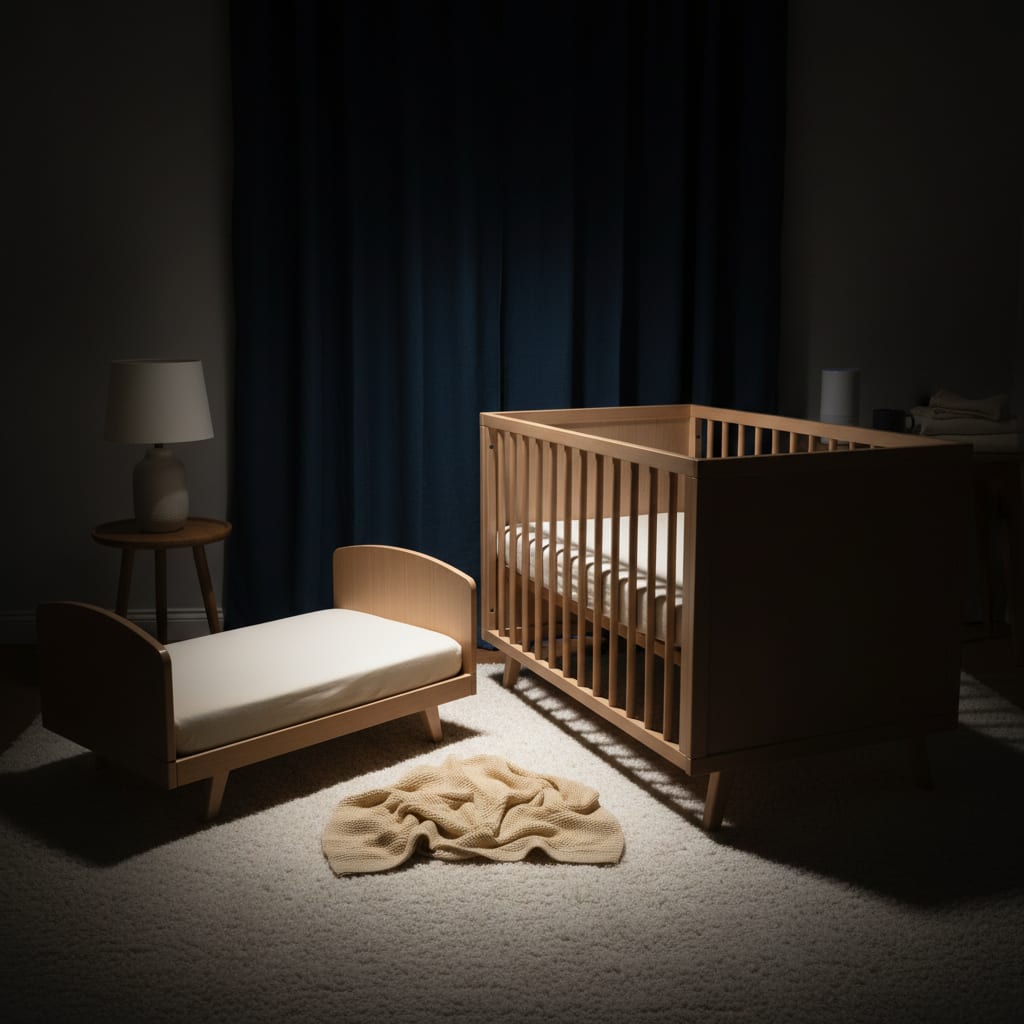
Until whichever comes first: the limit printed on your specific bassinet, or the day your baby can push up on hands and knees or shows signs of rolling. The federal safety standard for bassinets and cradles frames the product as not intended for use beyond roughly five months of age, or once a child can push up on hands and knees — and manufacturers set their own weight limits on top of that, commonly somewhere in the 15 to 25 pound band. Most families land on the move between three and six months, and the developmental trigger usually arrives before the weight one.
I’m a working sleep consultant, and this question almost always arrives already answered — the parent asking has seen the push-up and wants permission to have seen it.
The two limits, and which one bites first
The weight limit is the one printed in the manual. The developmental limit is the one your baby decides. They are independent, and you obey whichever you hit first.
In practice the development comes first for most babies, because a baby who can get onto hands and knees can lever themselves against a low bassinet wall long before they weigh twenty pounds. The wall height and the tipping stability that make a bassinet safe for a still newborn are exactly what stop working when the baby starts pushing.
Rolling counts too, and it counts early. If your baby is rolling in the bassinet, or arriving on their side, the bassinet is done — regardless of what the scale says.
What the federal standard actually says
Bassinets and cradles sold in the US are covered by a Consumer Product Safety Commission rule, and the CPSC’s business guidance for bassinets and cradles states plainly that the product is not intended to be used beyond about five months of age, or when a child is able to push up on hands and knees.
That “about five months” is a design assumption, not a birthday. A large four-month-old can outgrow a bassinet, and a small, late-rolling six-month-old may still be within limits on paper. Read it as the shape of the product’s useful life rather than as a date.
Weight limits vary by model — check yours
There is no universal bassinet weight limit, and any article that gives you one number is guessing on your behalf. Look on the underside of the frame, in the manual, or on the manufacturer’s product page.
As a worked example, HALO states a 20 lb limit on the BassiNest Swivel Sleeper, or until the baby begins pushing up on hands and knees or shows signs of rolling — whichever comes first. That “whichever comes first” structure is the part to copy: nearly every manufacturer writes the limit as a pair, and parents tend to remember only the number.
Bedside sleepers, travel bassinets that clip into a stroller frame, and the bassinet attachment on a play yard each carry their own separate limits. They are not interchangeable, and the stroller bassinet in particular is usually the shortest-lived of the three.
The other question hiding inside this one
Half the people asking mean something different: how many hours at a stretch is a bassinet safe for? There is no per-session time cap. A bassinet that meets current standards, with the mattress pad it was sold with, a fitted sheet, and nothing else in it, is a safe sleep surface for naps and for the whole night for as long as the baby is within its limits.
What does have a cap is the room-sharing question layered on top. Safe-sleep guidance favours the baby sleeping in the parents’ room, on a separate surface, for at least the first six months. That is about the room, not about the bassinet — which is why plenty of families move a crib in rather than stretching the bassinet’s life.
Sleep sacks, swaddles and the same deadline
The rolling milestone ends two things on the same day: the bassinet and the swaddle. If you are watching for one you are watching for the other, and the swap is to a sleeveless sack in the same weight. The full reasoning, including why the first signs of rolling matter rather than the first completed roll, is in rolling and stomach sleeping.
It is worth pre-buying the sleeveless sack before you need it. The night you discover the swaddle has to go is a bad night to discover you have nothing to put on instead.
If you are not ready to move yet
You are usually more ready than you feel. But there are two honest middle options: a play yard or travel crib in your room, which has a much longer life than a bassinet and is a legitimate full-time sleep surface, or the crib itself moved into your room until room-sharing ends.
Either way, do the move on your terms rather than on a night when the baby has just demonstrated why it was overdue. The staged version is in getting a baby to sleep in the crib, and if the bassinet has never worked well in the first place, the diagnostic order is in why the bassinet is being refused.
What I’d tell a client
Go and read the underside of your own bassinet tonight, and write the number somewhere you will see it. Then set your real trigger as the developmental one — hands and knees, or any sign of rolling — because that is the one that will arrive first and the one that will arrive without warning. Do not stretch it because the transition looks hard; a bassinet used past its limits is a different category of risk from a slightly worse week of sleep. And if you are choosing between a bassinet you are about to outgrow and a play yard you will use for two years, buy once. My colleagues at Only Mom Reviews take that purchase apart in do you actually need a bassinet, which is the gear question rather than the sleep one.
FAQ: bassinet limits
Can a 6-month-old still sleep in a bassinet?
Sometimes on paper, rarely in practice. If the baby is under the model’s weight limit and genuinely not rolling or pushing up, it is within the manufacturer’s terms — but six months is past the point most bassinets are designed around, and mobility usually ends it before the weight does.
What happens if my baby exceeds the bassinet weight limit?
Stop using it. The limit is about the frame, the stability and the tipping behaviour of that specific product, and there is no safe margin to borrow against. Move to a crib or a play yard that day rather than at the weekend.
Is it safe for a baby to sleep in a bassinet all night?
Yes, within the product’s limits and with a safe setup — the manufacturer’s mattress pad, a fitted sheet, nothing else in the space, and the baby on their back. There is no maximum number of hours.
Can I keep using the bassinet if my baby rolls but stays on her back?
No. The signs of rolling are the trigger, not a completed roll onto the stomach in front of you. Once she is capable of it, the bassinet’s walls and stability are no longer designed for the baby inside them.