Why Your Baby Won't Sleep in the Bassinet
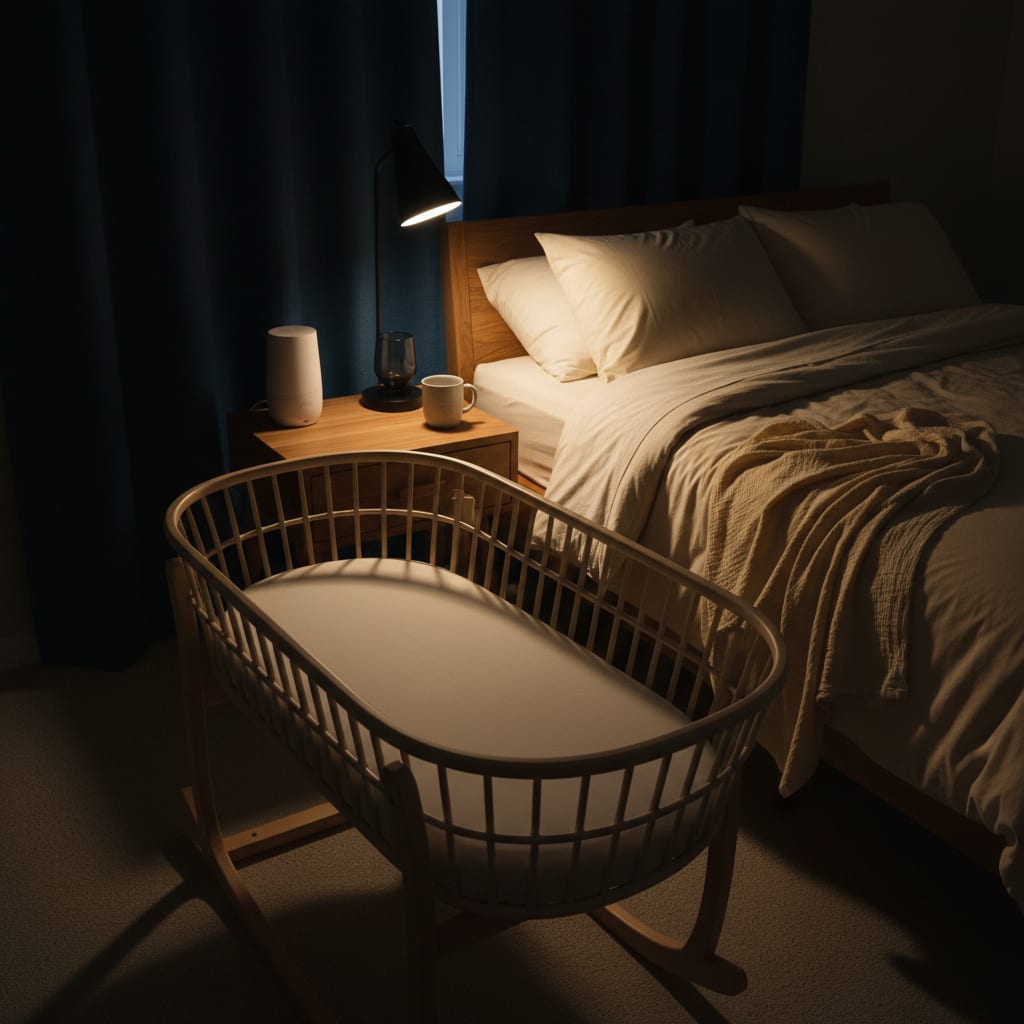
Usually because the transfer failed, not because the bassinet did. A newborn’s sleep is built to be shallow and social — light stretches, frequent stirring, a strong startle — so being set down onto a flat, cool, still surface is the moment most likely to end it. In the first two months this is ordinary behaviour rather than a fault in your baby or your bassinet, and it improves with unglamorous things: a warm-enough surface, a transfer timed to the right part of the sleep cycle, and a wake window that has not overrun.
I’m a working sleep consultant, and this is the question that arrives at 2am by text more than any other. Here is the order I actually check things in.
Start with the transfer, not the baby
Infant sleep cycles are commonly described as running around 50 to 60 minutes, and the deepest, most transfer-proof part sits a little way into the cycle rather than at its start. Practically, that means the standard advice — put them down the instant they close their eyes — sets you up to fail. Wait until the limbs go heavy and the sucking slows to nothing, which is usually somewhere past the five-to-ten-minute mark, then move.
Move slowly and in one piece. Lower the whole bundle in a curled position rather than unfolding the baby flat, keep a hand on the chest for a slow count once they land, and take your hands away one at a time. Bottom before head is the sequence most families find works, because the head-first version tips the vestibular system into a falling sensation.
If your bassinet has a high wall or you are reaching over the side of a bed, you are transferring at a bad angle before you start. That is worth solving with the furniture rather than with technique.
Temperature is the most common miss
A body-warm baby lands on a room-temperature sheet, and the change registers. You cannot preheat a mattress with a hot water bottle and leave it there — that is not safe — but you can dress the baby for the room rather than the arms that were holding them, which achieves the same thing without adding anything to the sleep space.
Check the room reading at bassinet height rather than at the thermostat. The full mapping of room temperature to sleepwear weight is in room temp and dressing, and it is the single change that resolves the most set-down failures in my consults.
The startle, and the swaddle question
The Moro reflex is exactly what it looks like: arms fly out, baby wakes, everyone is furious. A snug swaddle contains it, and for a young, not-yet-rolling baby it is a reasonable tool.
It has a hard expiry. Swaddling stops at the first signs of rolling — not the first completed roll — swapped for a sleeveless sack of the same weight, such as a micro-fleece HALO sack for a cool room. The reasoning behind that deadline is in rolling and stomach sleeping, and it is not a rule I bend for a baby who sleeps better swaddled. They all sleep better swaddled. That is the point of it.
Timing, in both directions
A baby put down with almost no sleep pressure will lie there and campaign. A baby put down well past their limit will be wired and hard to settle, and every subsequent attempt is worse. Newborn wake windows are short — often under an hour of genuine awake time including the feed — and the awake time starts when the eyes open, not when the feed ends.
Track two or three days of actual times before changing anything. In consults, the pattern I see is that the wake window parents describe and the wake window the clock shows are rarely the same number.
The setup checks worth running once
Darkness and sound do less for a newborn than they will at four months, but they cost nothing to get right, and they matter more once you are in a shared room. A continuous, low, steady sound source placed well away from the bassinet — a fan-based machine like the Yogasleep Dohm is the plainest version — masks the household rather than entertaining the baby, and it travels to the crib later without renegotiation.
Also check the obvious: a bassinet with a mesh side facing a bright window, a mattress that has a dip in it, or a sheet that is not the one the manufacturer sold you.
The rule-outs that are not mine
Some set-down refusal is a comfort problem I cannot fix from the outside. Persistent arching and pain-sounding crying after feeds, poor weight gain, noisy or effortful breathing, a baby who will only settle upright — those are pediatrician conversations, full stop, and no settling technique substitutes for the appointment. Reflux in particular gets treated with sleep positioners and inclined products online, and those are not safe sleep surfaces regardless of what the marketing says. Flat, firm, empty, on the back.
What I never recommend for this
Wedges and positioners, inclined sleepers, weighted sacks and blankets, and routine sleep in a swing or a car seat at home. I will describe them because parents ask, and I will not link them. If your baby only sleeps upright on a person, that is worth a call to the pediatrician rather than a purchase.
What I’d tell a client
Give it a fortnight of doing the boring things properly — dress for the room, transfer at heavy-limbs, keep the awake stretches honestly short — before you conclude the bassinet is the problem. Most of the babies I see labelled “bassinet refusers” at three weeks are sleeping in it by seven, with nothing bought in between. If the sleep is otherwise fine and the only casualty is your evening, you have a normal newborn and a hard month. If the baby is uncomfortable, feeding badly or not gaining, stop troubleshooting sleep and ring the pediatrician — that is a different problem wearing this one’s costume. And check how long a bassinet is actually good for before you invest weeks in winning a battle you are about to age out of.
FAQ: babies and bassinets
Why does my baby wake up the second I put her down?
Most often a combination of transfer timing and temperature change. Wait for the deeper part of the cycle, lower bottom-first with a hand held on the chest afterwards, and dress her for the room she is being put into rather than the body she has been asleep against.
Is it normal for a newborn to hate the bassinet?
Very. Contact sleep is the default setting for a newborn, and preferring it is not a habit you have accidentally created. It usually eases over the first couple of months as sleep consolidates.
Can I let my baby sleep in a swing or a car seat instead?
Not for routine sleep. Sleep that happens in a car seat on a journey is unavoidable; deliberately arranging sleep in an inclined seat at home is not recommended, and the same applies to swings and loungers. Move them to a flat, firm surface when you get in.
Should I just skip the bassinet and use the crib?
You can, and plenty of families do. A crib in your room is a perfectly good newborn sleep space if it fits — the room-sharing benefit belongs to the room, not the furniture. The staged version of that move is in getting a baby to sleep in the crib.