Lavender for Baby Sleep: Evidence and Essential Oil Safety
Lavender for baby sleep has very little evidence behind it. A short 2008 study found babies cried less and slept more deeply after a lavender-scented bath. The NIH’s complementary-health centre still says it is unclear whether lavender aromatherapy helps sleep. The risks are better documented. Essential oils can poison a child who swallows them, can irritate skin, and a diffuser puts fine particles into the room. A few children have also developed breast swelling after repeated use of lavender products on the skin. Ask your pediatrician before using any oil on or near a baby, and lock the bottles away.
I make my living in this industry, and I am not a clinician. This post looks at where scent fits in a bedtime routine. Whether any product is safe for your child is a pediatrician conversation, full stop.
Why lavender keeps coming up
In consults, the pattern I see is a nursery that has collected “sleepy” products: a lavender bath wash, a calming lotion, a diffuser on the dresser, sometimes a roll-on for the parent’s wrists. The baby still wakes because of a feeding habit, a short nap or a bedtime that drifted late. The scent is rarely what is doing the work.
Lavender feels gentle and natural, which is understandable. But “natural” is not a safety rating.
What the evidence actually says
The study people usually mean when they say lavender helps babies sleep is Field and colleagues, 2008, a three-page report in Early Human Development. Very young infants were bathed with or without lavender-scented bath oil. In the lavender group, the mothers were more relaxed. The babies cried less and spent more time in deep sleep after the bath, and cortisol fell in both mothers and babies. The abstract does not give the number of infants. It measured the period straight after the bath, not how the night went.
The second study often grouped with it is a 2016 trial of 76 mothers who massaged their newborns at bedtime with lotion, without lotion, or not at all. The lotion group did best on night waking and sleep length. Two caveats. The abstract does not name a scent, although a 2024 review in the World Journal of Pediatrics describes it as lavender-scented. And the authors themselves suggest the lotion mothers simply massaged more often, which tracked with better sleep. Europe PMC lists the funder as Johnson and Johnson Consumer Inc.
That review notes “a lack of evidence on children and adolescents”.
The NIH’s National Center for Complementary and Integrative Health is no warmer. Its lavender page says it is “unclear whether aromatherapy with lavender oil has benefits for… sleep quality or insomnia”. Its aromatherapy page says we don’t know whether aromatherapy helps insomnia “because little rigorous research has been done”.
A bath, a massage and a calmer parent may all help a baby settle. Nobody has shown that lavender is the active ingredient.
The safety cautions
Swallowing is the serious one
Poison Control’s page Essential oils: Poisonous when misused, by a clinical toxicologist and a pharmacist, says “Misuse of essential oils can cause serious poisoning”. It also says aspirating an oil, when a child chokes and some goes into the lungs, “can cause pneumonia”.
One of its case reports is about lavender. An 18-month-old swallowed “a small amount of lavender extract” his mother used as a home fragrance. Three hours later he was “extremely drowsy and confused”, with an abnormal brain-wave test. He recovered in about six hours. The page also warns about swallowing wintergreen, camphor, eucalyptus and sage oils, with seizures among the reported effects. It notes that “Children have thin skin and immature livers”.
Its prevention advice for homes with young children is blunt. Consider discarding bottles of essential oils, or lock them “out of the sight and reach of children and pets.”
Skin: dilute, and stop at the first rash
The same page says diluting oils in a carrier oil “is the best way to avoid a bad reaction”, that not every oil suits skin at all, and to stop using a product immediately if a rash appears. NCCIH adds that topical lavender “may cause allergic skin reactions in some people.” I won’t suggest a dilution for a baby; that is your pediatrician’s call.
Diffusers put particles in the room
A 2021 chamber study in Indoor Air ran an ultrasonic diffuser with lemon, lavender, eucalyptus and grapeseed oils. Every oil released volatile compounds and fine particles. Tap water instead of deionized water raised one oil’s particle output fivefold. The authors conclude these diffusers “can contribute substantially” to indoor particle levels. It measured the air, not babies, but it is enough to keep a running diffuser off my nursery checklist. Poison Control adds that reed diffusers use oil dissolved in rubbing alcohol and must be kept out of children’s reach.
Hormone effects: a real signal, not a settled one
In 2007 the New England Journal of Medicine published three cases of breast growth in prepubertal boys. Each coincided with products containing lavender and tea tree oils, and each resolved after the products stopped. Lab tests on human cells found the oils had oestrogen-like effects. A 2019 follow-up added three girls and one boy with continuous exposure to lavender fragrances. The breast growth faded in all of them once the products stopped. That paper also says it is “unknown” whether lavender oil is potent enough to cause this.
NCCIH’s reading is the right register: a few cases have been reported, and “it’s unclear whether the lavender was responsible.” That is no reason to panic about one bath, but it is a reason not to use lavender on a child daily for months without a doctor knowing.
What I’d use instead
Repetition, not scent, is what makes a routine work:
- Keep the bath, skip the oil. A warm bath is a strong cue in its own right, and it was part of both studies above.
- Use sound as the steady cue. A consistent fan-style sound such as the Yogasleep Dohm gives the room a signal that never changes. My white noise setup guide covers placement and volume.
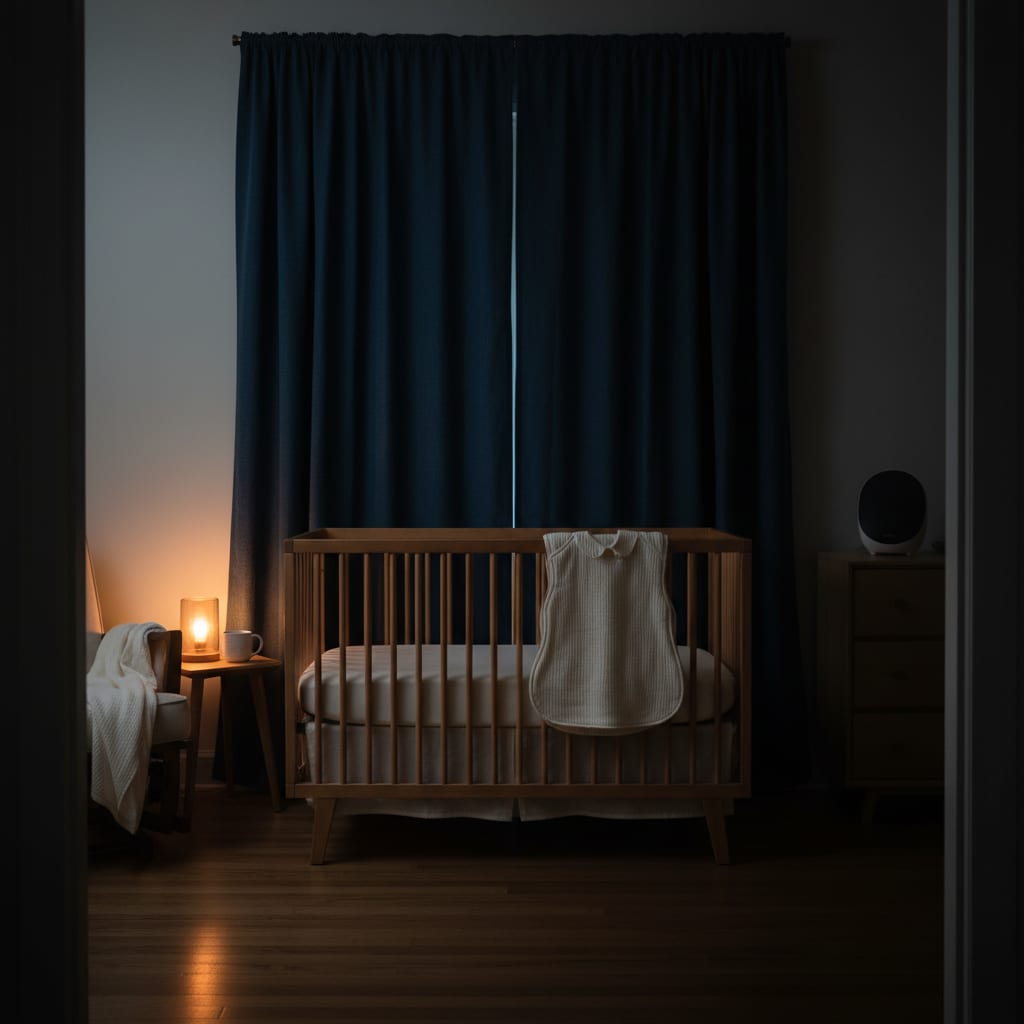
- Keep the sleep space bare. Nothing scented in or on the crib. Betteroo’s guide to a plain, bare sleep space lists what belongs there, which is very little. My nursery checklist covers light, temperature and the rest of the room.
If the real question is whether something can make your child sleepy, the same caution applies to supplements. My post on melatonin for kids covers that one.
What I’d tell a client
You don’t need lavender to fix this, and I can’t tell you it will help. If you love the smell, enjoy it in your own space, and keep every bottle locked away. Before anything goes on your baby’s skin or into the nursery air, ask your pediatrician. Then let’s look at the timing and the settling, because that’s where the night is actually being decided.

FAQ: lavender and essential oils for baby sleep
Does lavender help babies sleep?
There is no good evidence that it does. One short 2008 study found less crying and more deep sleep after a lavender-scented bath, and NCCIH says it is unclear whether lavender aromatherapy helps sleep. The bath and the calm around it may be doing the work.
Is it safe to use a diffuser in the nursery?
The studies I could find did not measure infants directly. A 2021 lab study found diffusers release volatile compounds and fine particles into the room. Ask your pediatrician first, and never leave a diffuser or reed diffuser within a child’s reach.
Can I put lavender oil on my baby’s skin?
Not without your pediatrician’s agreement. Poison Control advises diluting oils and stopping at any rash, and some children have had breast swelling after long-term lavender use on the skin.
What should I do if my child swallows essential oil?
Contact Poison Control right away: 1-800-222-1222 in the US, or its online tool. Its first-aid page says to call 911 immediately if your child collapses, has a seizure, has trouble breathing or can’t be woken.