Outgrown the Bassinet, No Room for a Crib: Options
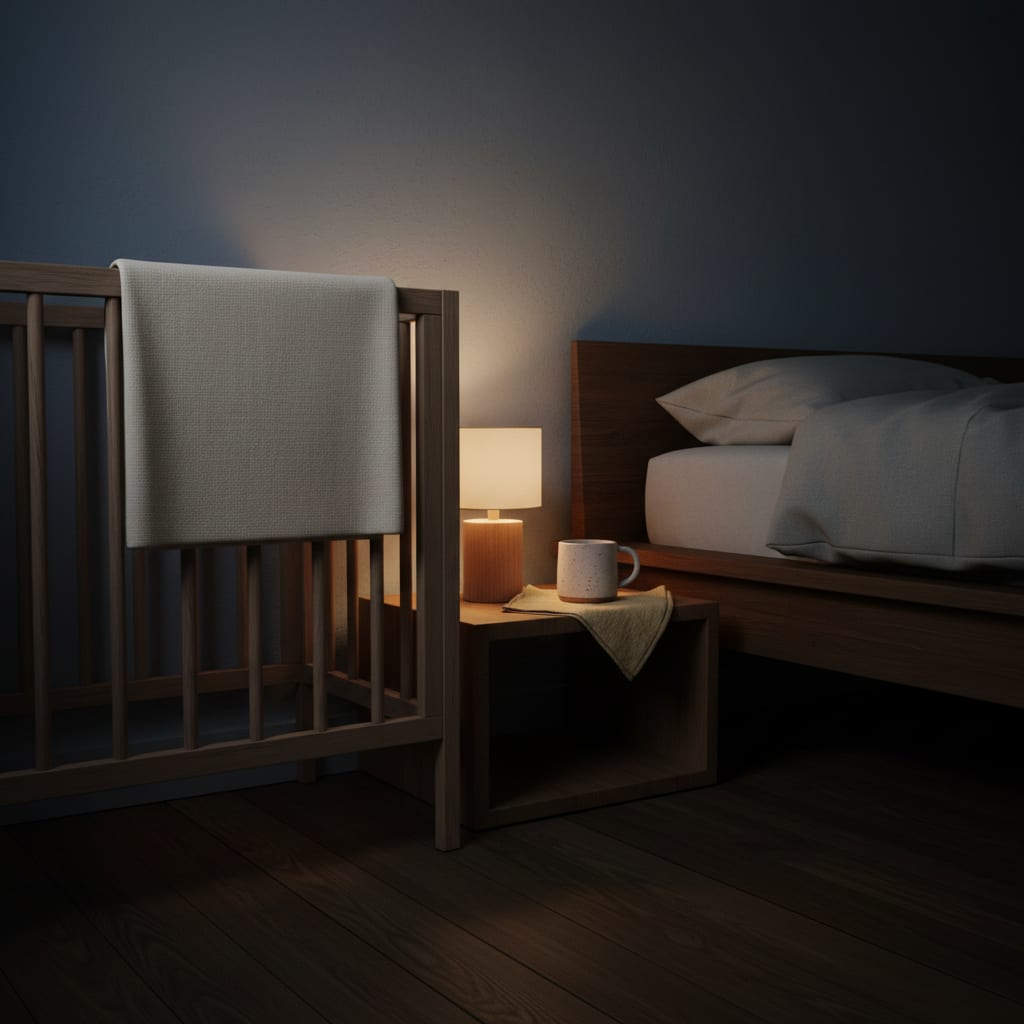
There are three options that actually fit, and one that only looks like one. A mini crib — a non-full-size crib in the federal standard’s language — takes roughly a foot off a full-size crib’s length and is a legitimate full-time bed. A play yard is the other legitimate full-time bed, and it folds. Third, move the crib in and move something else out, which is more often possible than it feels at 11pm. What is not an option is stretching the bassinet past its limits, or moving the baby into your bed because the furniture didn’t fit.
In consults, the pattern I see is that this arrives as a furniture problem and gets solved as one, when what needs deciding is which sleep surface the baby will be using in four months. Buy for that one.
Measure before you shop
A full-size crib feels non-negotiable because its size is fixed by law rather than taste. The federal standard defines it by interior dimensions: 16 CFR 1219 states the interior “shall be 71 ±1.6 cm (28 ±5/8 in.) wide … and 133 ±1.6 cm (52 3/8 ±5/8 in.) long,” within a range of ±2 inches. Add the frame and you need something near 30 by 54 inches of floor, plus the reach to get a baby in and out.
So measure three things first: the wall run you could clear, the door’s swing, and the gap you need to stand in beside the rail. That last one is what people forget and then live with for two years.
A mini crib buys you a foot of length
A mini crib is not an unregulated downgrade. It has its own federal standard — 16 CFR 1220, for non-full-size baby cribs — which covers the “undersize crib,” defined there as one with an interior length under 49 3/4 inches or a width under 25 3/8 inches. That is where most products sold as mini cribs fall, and the standard sits on the same ASTM structural test suite the full-size rule uses.
What it buys you is length: mini cribs typically run around 38 to 40 inches against a full-size crib’s 52-plus, which is often the difference between fitting beside your bed and not.
What it costs you is runway. A mini crib ends at the same milestones a full-size crib does — pulling to stand with the mattress at its lowest setting, then climbing — but it also ends on sheer length, because a tall two-year-old runs out of bed. Plan on the first year comfortably and the second maybe, and check whether the model converts. The Babyletto Origami is the folding version I see most in small rooms, on wheels, which matters when the crib has to move to open a closet.
One thing to get right: mini cribs take mini-crib mattresses, firm and made for that frame, with no gaps at the edges. Do not solve a loose fit with a rolled towel or an extra pad.
The play yard, used as an everyday bed
A play yard is a real sleep surface, not a compromise, and I say that to at least one family a month who thinks of it as camping gear. Play yards made for the US market fall under 16 CFR 1221, which requires compliance with ASTM F406 — the same standard family that governs non-full-size cribs. NIH’s Safe to Sleep names a “portable play yard” alongside a crib and a bassinet as an infant sleep space in its room sharing guidance.
The thin, firm mat it comes with is the correct mattress. It feels wrong to an adult hand and it is right for a baby. Adding a foam topper or a softer mattress bought separately turns a compliant sleep surface into a non-compliant one, and that is the most common way I see this option go wrong.
The trade is footprint versus fold: a standard play yard is not dramatically smaller than a mini crib on the floor, but it collapses when you need the floor back, and it travels. A Graco Pack ‘n Play is the default here for a reason. If your model has a removable bassinet or napper insert, those carry their own lower weight and milestone limits — a baby who has outgrown a bedside bassinet has very likely outgrown the insert too, and belongs on the play yard’s own floor.
Move the crib in and something else out
Before accepting that the room cannot take a crib, price the alternative — a mini crib plus its mattress is real money for a bed with a shorter life than the one you already own.
The changing table is nearly always the piece to lose; changing on a mat on the floor or the bed costs nothing and frees a footprint close to a crib’s. A dresser can move to a closet or hallway, and a bedside table can become a shelf. If the crib is only there for the room-sharing window, it is a temporary layout, which makes an ugly solution easier to accept.
Does this mean moving them to their own room?
Sometimes, and that is a legitimate answer — but make it a decision rather than a consequence of furniture. Safe to Sleep is direct that room sharing means “baby sleeps in the same room as parents or adults, near or next to the adult bed, but in a separate sleep space that is made for infants,” and that research shows it “reduces the risk of SIDS and sleep-related infant deaths.” That outranks the floor plan.
If the move is genuinely on the table at your baby’s age and you want the practical version, Betteroo’s read on when to move a baby into their own room is a sensible starting point. Anything about your particular baby’s breathing, feeding or growth is a pediatrician conversation, full stop.
What doesn’t count as an option
Stretching the bassinet is the big one. The limits are the model’s stated weight and the developmental triggers — pushing up on hands and knees, or any sign of rolling — and the reasoning is in how long a baby can sleep in a bassinet. A bassinet used past its limits is a different category of risk from a worse week of sleep.
The others: an adult bed is not a solution to a furniture shortage; a sofa or armchair is the highest-risk surface there is; inclined sleepers and loungers are not sleep surfaces at all.
Do the move in a week you choose
Give the new bed a week of naps before it takes a night, change one thing at a time — a new bed and the end of the swaddle in one week is the classic self-inflicted bad week — and decide in advance what you are doing at 2am. The staged version is in getting a baby to sleep in the crib, and the light and sound side of a shared small room is in the nursery checklist.
What I’d tell a client
Measure tonight, and measure the standing gap beside the rail rather than only the wall. Then pick the surface you will still be using in six months, not the one that solves this week: for most small rooms that is a play yard on its own floor, the cheapest legitimate bed with the longest life, and it disappears when you need the floor back. If you would rather have furniture that looks like furniture, a mini crib is a real crib under a real standard and I have no objection — you are buying a shorter runway, that’s all. Do not let a tape measure push you into the bed. The furniture is negotiable; the surface is not.

FAQ: small rooms and sleep surfaces
Is a mini crib safe for a whole night, every night?
Yes — with the mattress made for that frame, a fitted sheet, and nothing else in it. A mini crib sold in the US is covered by the federal non-full-size crib standard. The limit is runway, not safety.
Can a baby sleep in a play yard long term?
Yes, on the play yard’s own floor with the mat it was sold with. Safe to Sleep lists a portable play yard as an infant sleep space alongside a crib and bassinet. What is not long-term is the bassinet or napper insert some models include — those carry their own lower limits, and once the baby is pushing up or rolling they are done.